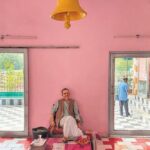

In 1911, with the transfer of the imperial capital from Calcutta to Delhi, the northern Ridge near Civil Lines was drawn into the military geography of the new administration. Rural tracts were acquired and reorganised under a planned regime. By the 1930s, Banarasi Dass Chowdhury and his family had secured land from the colonial government in what would become Timarpur, now identified as the BD Estate near Civil Lines. Construction extended from 1930 to 1966, with Anand Prakash Chowdhury building a series of houses on these plots.

Between the 1930s and 1947, these structures answered to the administrative needs of the area. Seven houses were constructed to a near-identical plan. The conventional layout of the Indian house was reworked to permit subdivision and rental to multiple tenants, anticipating demand generated by the expanding bureaucracy and the nearby Delhi University.
One such house, now associated with Aunty Kalyani, preserves an account of Timarpur in the 1960s and 1970s. It was acquired by a chemistry professor from Allahabad who had moved to teach at the university. He considered building near Lady Shri Ram College for Women, then set within agricultural land, but chose instead to purchase a bungalow in Timarpur. In 1966, the property was requisitioned by the state for staff housing, delaying occupation by the family until 1975.
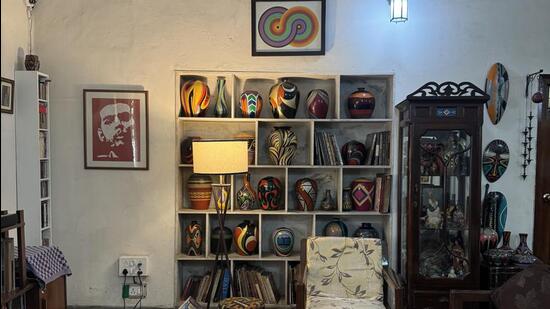
When you enter the house, you’re greeted by the smell of old books, walls of paintings and projects, and comfortable seats to read the day away. Would anyone expect anything different from an academic house? When I first visited on a working Monday morning, Aunty Kalyani took me through the history of the house while dreaming of an evening scene after dinner: the breeze of the old fan, the cool interiors, the sounds of animals from the Ridge, a rich bookstand with prized first editions, and a sturdy Godrej table that sustained many paper markings. The house was essentially a classic Delhi Domestic Deco house, showing how an international design movement translated into a home by the Ridge, neighbouring the post-colonial Civil Lines area.
The design of the house allowed for this transition. It rises over two and a half floors with a barsati above. Each bedroom is paired with an attached bathroom and a small ancillary room, enabling independent tenancy within a single structure. The plan reflects foresight – a necessary ethic for a time when Delhi was seeing newer populations put roots into the urbanism of the city. Modernism, aspirational futurism, and austere functionalism are all at play in this Delhi house.
The façade carries restrained Art Deco elements, which extend into the interior. The entrance opens into a stairwell that serves each level independently. The handrail and steps are executed in terrazzo with minimal ornament. The stairwell is lit through green-tinted windows aligned with the exterior palette. Each floor maintains high ceilings, terrazzo flooring, and a sequence of drawing and dining spaces leading to two bedrooms that open towards the rear.
The house adapts the established grammar of the Indian home without abandoning it. The courtyard is displaced to the back but retains its functional role. The two principal floors are identical in plan. The barsati remains in use as a rental unit, open on multiple sides, with a small service space and a terrace overlooking what survives of the Ridge.
The neighbourhood acquired a distinct social profile. It came to be known informally as a Bengali colony, reflecting the presence of Bengali academics and administrators associated with the university and government service. Cultural institutions followed. Durga Puja continues to be held in the vicinity. A Bengali school operates nearby. The area functioned as a residential extension of the university and the administrative city.
When the family took possession in 1975, the house showed the effects of nearly a decade of institutional use. Modifications were made. Doors were replaced, materials reinforced. These changes remain. The structure itself required limited intervention. Its scale and proportions have sustained it across decades of occupation.
This house records a phase in the making of the northern edge of the city. Around Civil Lines, institutions such as Indraprastha College for Women and residential developments formed a stable social environment for academics and professionals moving out of Shahjahanabad. It reflects a moment when domestic architecture, state demand, and urban expansion were aligned.
The landscape that made this possible has since been altered. The Ridge, once continuous across this belt, extended into Timarpur as forest and exposed stone. From the 1960s, it was reduced through quarrying and construction. Rock was blasted to make way for housing, campuses, and roads. The ecological field that shaped early settlement patterns receded under urban pressure.
Residents who recall the area from the 1960s describe a different register of sound and movement. Bird calls marked the day. Jackals could be heard at night from the Ridge. These have largely disappeared. In their place is the continuous noise of traffic. The transformation is not only spatial but sensory. What remains of the Ridge persists as fragments, and as memory, held in accounts that outlast the ground from which they arose.