


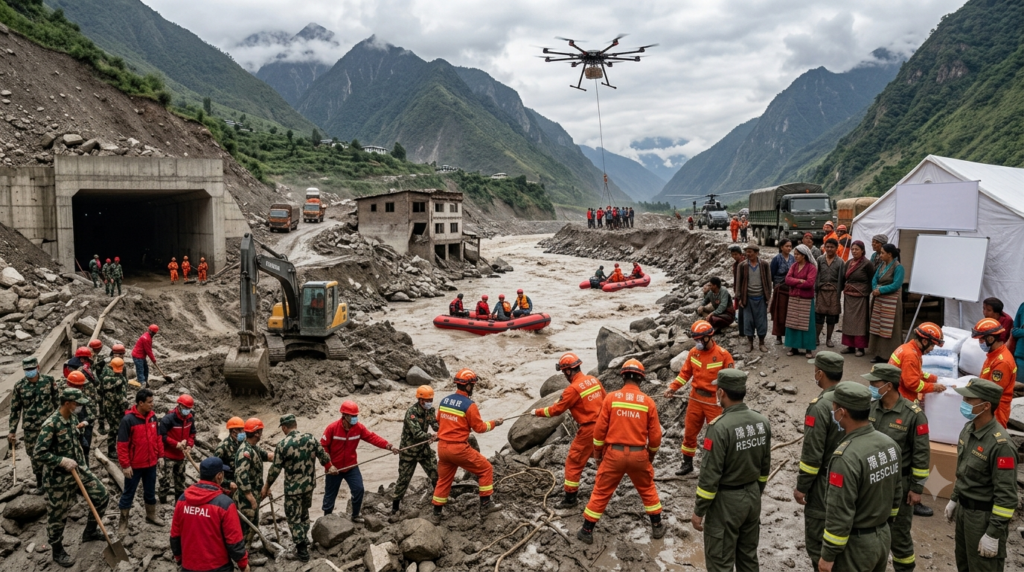


Rescue operations have recommenced following a short break; however, experts warn about the risks posed by a recently formed lake.
Rescue operations have resumed in the flood-stricken region along the Nepal-Tibet border after a brief pause due to concerns about another potential glacial flood. The death toll has climbed to 633, with nearly 3,000 people still unaccounted for.
Nepalese police reported that fatalities have increased to 626 as of Saturday. The country’s disaster management authority stated there are 2,426 missing persons on the Nepalese side of the border, including 517 foreigners, possibly tourists or foreign workers. Chinese officials have noted that in Tibet, the death toll has reached at least seven, with 554 missing individuals. Al Jazeera‘s Minelle
Fernandez, reporting from Kathmandu, noted that Nepal’s government has sought specialized assistance from India and China to “address gaps” in their rescue operations. These teams, which include tunnel rescue experts, are expected to arrive later on Saturday. Fernandez highlighted that the Nepalese foreign ministry spokesperson justified the request for help by emphasizing the urgency and lives at risk. Initially, Nepal had hesitated to seek external assistance to avoid potential chaos from deploying large teams across different areas. The disaster commenced on Wednesday morning following the collapse of a
glacier at an altitude of approximately 5,200 meters in the Himalayas. This event triggered a massive flow of rocks and debris downwards nearly 1,200 meters into the Lende River. The surge subsequently moved southwards through Nepal‘s Rasuwa, Nuwakot, and Dhading districts, at one point elevating the Trishuli River by 9 meters within 30 minutes. The US Geological Survey revised an earlier assessment, determining that the seismic activity resulted from the landslide itself rather than an earthquake. A new lake formed at the collapse site and began rising, which initially halted search efforts due to fears of another flood. However, operations have now resumed as the lake‘s risk is considered manageable. Alton Byers, an expert in glacial hazards from the University of Colorado Boulder’s Institute of Arctic and Alpine Research, expressed concern over the unstable barrier holding back the new lake. Composed of loose debris from two days prior, it offers “not much holding it together.“
Byers suggested that a natural, gradual drainage would be safest and noted that Chinese teams might also attempt to manually lower the lake using hand tools and other methods—a technique used in countries vulnerable to glacial lake outburst floods. Chinese Premier Li Qiang visited Gyirong’s disaster area on Thursday, while President Xi Jinping chaired a meeting directing officials to “develop scientific search-and-rescue plans“ and enhance monitoring of glacial lakes, according to state media. International aid has arrived from India, the UN, the Red Cross Federation, Australia, South Korea, and the US. Officials caution that the death toll could continue rising as rescuers reach areas still isolated by mudslides and damaged roads.